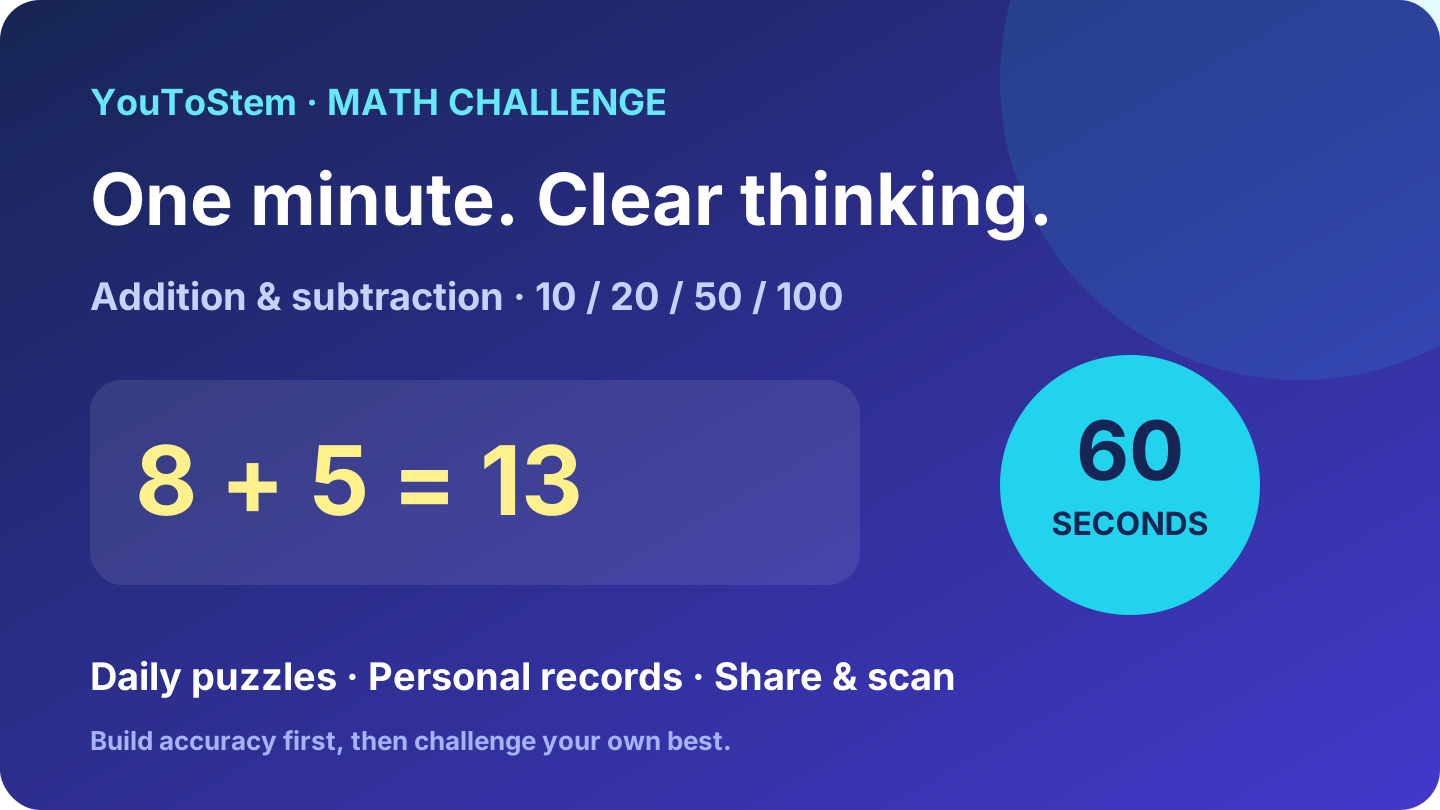
Arithmetic Challenge Guide: One-Minute Sprints and QR Score Cards
Arithmetic Challenge gives addition and subtraction practice a clear finish: one minute. You can solve as many questions as possible, or choose a target count and try to finish before the minute expires. Both modes record mistakes, so accuracy remains visible alongside speed.
Quick start: choose a range and a goal
Start with a range you understand comfortably, choose a mode, and press Start. The timer begins only when you start the run. Use the on-screen keypad or number keys to enter your answer. Complete answers are checked automatically without confirmation, and correct answers move straight to the next question. Two- and three-digit answers wait until all digits are entered. Read the operator on every question before calculating.
Which range should a beginner choose?
Within 10 is a useful first choice for someone familiar with the meanings of addition and subtraction. If those ideas are still new, practise combining and removing physical objects before using the timer. Choose a range based on understanding rather than age alone.
What the four number ranges include
The limits are 10, 20, 50 and 100. Both operands and the answer stay between zero and the selected limit. Within 10 can include 6 + 4 or 10 − 3, but not 8 + 7. Within 20 can include 8 + 7 because its answer, 15, is also within the limit. Subtraction never produces a negative answer.
Why are there questions with zero?
Zero is part of the range. Questions such as 0 + 7, 7 − 0 and 7 − 7 distinguish adding nothing, removing nothing, and removing everything. In the new deck, adding zero, adding to zero and subtracting zero together make up at most 10% of questions and are spaced apart. Subtractions whose result is zero remain available. Always check the operator before answering.
How are addition and subtraction balanced?
Operations alternate. A deck contains no duplicate expression, and a shared seed recreates its order. An exceptionally fast player who finishes the entire deck cycles back to its beginning. Normal free-play restarts shuffle a fresh deck; repeating a shared challenge deliberately preserves the original sequence.
The two one-minute modes
The 60-second sprint
Solve as many questions as you can before 60 seconds expire. A higher correct count is better; fewer mistakes break ties. The personal best belongs to this browser, not a global leaderboard. A rushed operator error often costs more time than taking a brief moment to read accurately.
Finish a target
Choose 10, 20, 30 or 50 questions and finish them within 60 seconds. The clock stops as soon as the final required answer is correct. Completed attempts are compared by time, then mistakes. If the timer expires early, the game records how many you solved rather than claiming that the target was completed.
Wrong answers stay for another try
A wrong answer adds one mistake and leaves the current question in place. You can work it out again rather than losing the opportunity to understand it. Accuracy is the number of correct attempts divided by correct attempts plus mistakes. Several guesses on one question therefore remain visible in the result.
How can I avoid guessing repeatedly?
Reconstruct the calculation instead of trying neighbouring answers. If 14 − 6 went wrong, think of 14 − 4 − 2: reach ten, then remove two more. This is more informative than entering 7, 8 and 9 in sequence. Identify whether you missed the operator, lost a step or miscounted.
Making ten for addition
For 8 + 5, split five into two and three. Eight plus two makes ten; three more makes thirteen. The same idea works for 9 + 6: take one from six to reach ten and add the remaining five. The purpose is to connect an unfamiliar sum to a familiar whole.
Must I split every question?
No. If you know 3 + 4 comfortably, use that fact directly. Making ten is a strategy for understanding sums that cross ten, not a requirement to add extra steps to every calculation. Use a method you can explain, and let familiarity shorten it naturally.
Using whole tens in subtraction
For 13 − 5, subtract three to reach ten and then subtract the remaining two. For 42 − 17, one option is 42 − 10 = 32 and 32 − 7 = 25. Another is to remove two first, reach forty and subtract fifteen. Choose the sequence that is easiest to track accurately.
How do I check a subtraction answer?
Use the inverse addition: if 42 − 17 is 25, then 25 + 17 should return to 42. During a timed run, a rough magnitude check can still help. Removing a number in the teens from 42 should not leave a result larger than 42 or close to zero.
Daily settings and a shared daily sequence
Daily Challenge lets you choose the range, mode and target count. This browser remembers those settings separately from free-play preferences. Everyone using the same UTC date and settings receives the same deck and order, so compare results only after checking those conditions match.
What happens on another day or device?
The date follows UTC rather than each player’s local midnight. A new date changes the daily sequence while keeping your saved preference in this browser. Clearing site data, private browsing, a different browser or a different device may remove access to saved settings and records. They are not automatically synchronised to an account.
Create a card and invite a friend
After a run, choose Create challenge card. The portrait PNG includes the range, mode, score, mistakes, accuracy and a QR code. Save the image and send it to a friend. A camera or an app with photo QR recognition can read the code, open the challenge URL and let your friend press Start.
The link preserves the seed, so an older daily card still recreates its original questions after the date changes. Keep the white margin around the QR code and avoid covering it with stickers. If direct image sharing is unavailable, save the PNG and send it from your photos, or copy the challenge link instead. An internet connection is needed to open the game.
Compare records under matching conditions
A score of thirty within 10 is not directly comparable to twenty within 100. Match the range, mode and target first. Look for fewer mistakes before treating a small speed gain as improvement. Shared scores are self-reported local records rather than server-certified competition results.
Can I pause by switching tabs?
No. The game uses elapsed time rather than counting only visible updates. Time continues in the background, and returning after the deadline ends the run. Answers submitted at or after the deadline cannot add a point. If you are interrupted, starting a new attempt gives a clearer comparison.
Use a short run to notice what needs practice, then work through those calculations without racing. When you want a different mathematical task, try 24 Point for combining operations. Schulte Training offers a different short visual-search challenge with its own timing and error measures.