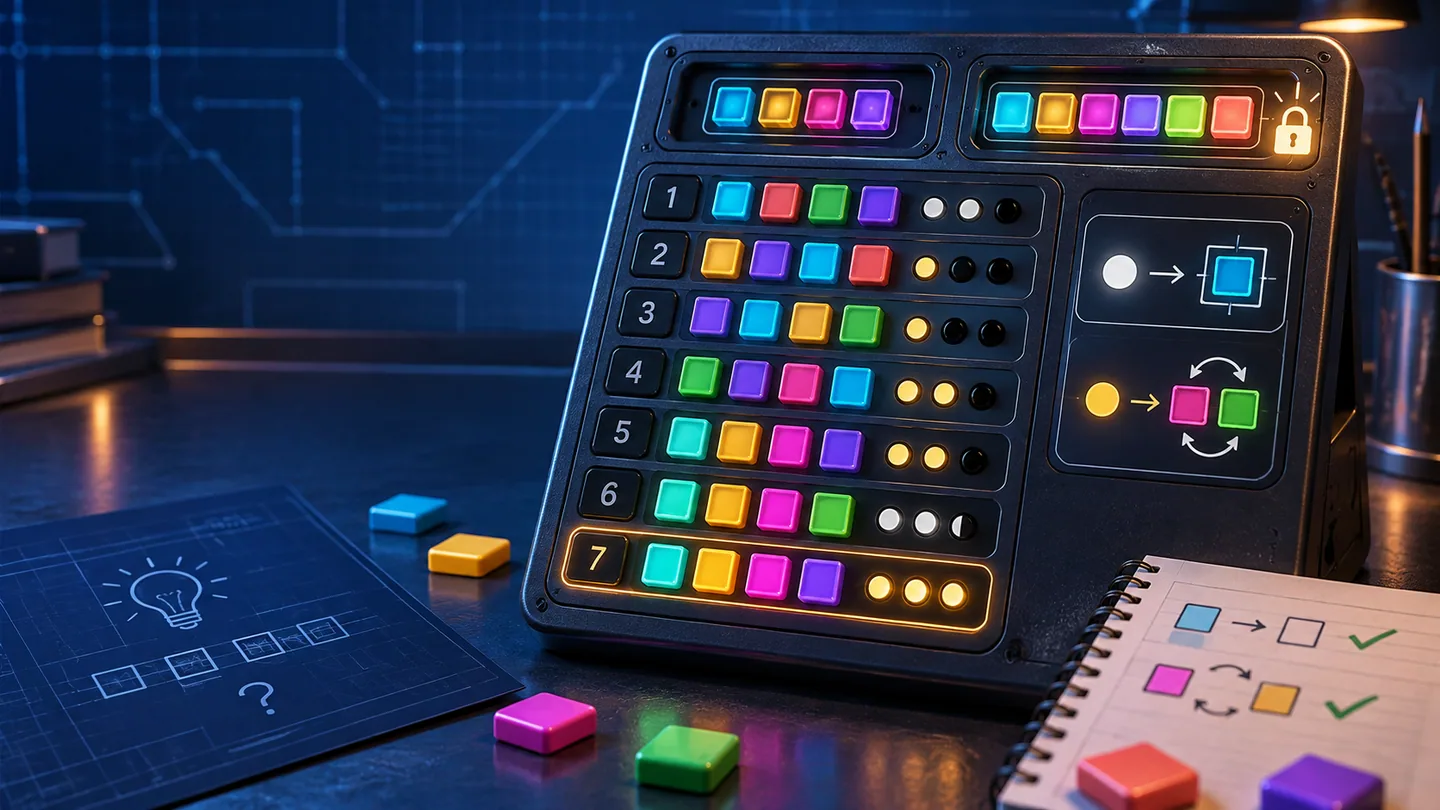
Color Code Breaker Guide: Solve 4- and 6-Slot Codes
Color Code Breaker is a deduction game, not a guessing contest. Starter and advanced puzzles use four different colors; master puzzles use all six. Identify both the correct color set and its exact left-to-right order.
Quick answer
Use early attempts to discover which colors belong in the code, then use controlled swaps to determine their positions. Change as little as possible between related guesses: when only one color or one pair of positions changes, the new feedback has a clear cause.
Starter levels identify each correct position directly. Advanced levels report two totals: exact means the color and position are both correct; misplaced means the color belongs in the code but occupies another position.
Rules and feedback
Every slot contains a different color. Four-slot puzzles allow seven attempts, while six-slot master puzzles allow ten. Two optional hints can reveal a fixed position without using an attempt.
Per-cell feedback
Levels 1–200 mark each of the four guess positions. A green check means that slot is exact. A red cross means the slot is not exact; the color might still belong elsewhere, so compare it with other rows before discarding it.
Count-only feedback
Levels 201–600 hide positions. A result of 2 exact, 1 misplaced means three guessed colors occur in the secret: two already occupy their final slots and one must move. In master levels the same clue logic applies across six slots.
What a clue does not say
Count feedback does not identify which disc earned which point. Never attach a total to a particular slot without another comparison. A clue narrows a set of possible codes; it is not a complete instruction for the next move.
A worked example
Assume the six-color palette is cyan, amber, magenta, violet, lime, and coral. Your first guess is:
cyan – amber – magenta – violet
The result is 1 exact, 2 misplaced. Therefore three of those four colors are in the code, and one is absent.
For the second guess, keep the first three positions and replace violet with lime:
cyan – amber – magenta – lime
If the result improves to 2 exact, 2 misplaced, all four colors in the second row belong to the secret, violet is excluded, and lime is included. Because only the last color changed, the increase can be attributed to that replacement. You can now stop testing new colors and begin swapping positions.
Why controlled changes matter
Changing all four slots creates a new result but little explanation. Changing one color tests membership; swapping two colors tests order. This is the same experimental principle used in debugging: alter one variable and observe the effect.
An attempt-by-attempt plan
Attempts 1–2: identify the set
Use four different colors, then replace only one or two colors. Compare the combined total exact + misplaced. If it rises, at least one new color belongs; if it falls, a removed color belonged. With a four-color palette in the earliest levels, the set is already known and these attempts can focus on order.
Attempts 3–5: locate anchors
Once the likely set is known, preserve exact positions and swap only unresolved slots. If swapping positions two and three increases the exact count by two, both swapped colors have reached their correct positions. If the count stays unchanged, neither conclusion is automatic; compare with another controlled swap.
Attempts 6–7: verify, do not explore
Late attempts should resolve the smallest remaining candidate set. List the remaining permutations mentally or on paper. Choose a guess that distinguishes them instead of introducing a color already shown to be absent.
How difficulty increases
Levels 1–24 use four available colors and direct feedback. Levels 25–144 expand the palette to five, and levels 145–200 introduce all six. Levels 201–400 retain four slots with all six colors but switch to count-only clues. Levels 401–600 form the master tier: every password and guess expands to six slots, count-only clues remain, and the attempt limit becomes ten. Campaign permutations are assigned without duplicate level signatures.
The daily challenge uses count feedback and may select an advanced or master puzzle. Everyone receives the same date-based puzzle, which makes results comparable without storing a daily answer on the server.
Using the two hints wisely
A hint reveals one exact slot. It is most valuable when several remaining codes differ mainly at that position. Using both hints before making a first comparison wastes information that normal feedback could have provided.
Try a no-hint solution first. If two attempts remain and three or more permutations are still plausible, reveal one slot, remove every incompatible candidate, and save the second hint for a genuinely unresolved position.
Common mistakes
- Replacing several colors and rearranging every slot in the same attempt.
- Treating a misplaced color as if it belonged in a specific position.
- Forgetting that every slot must use a different color.
- Repeating a previous information pattern with no new test.
- Spending both hints before reading the first two feedback rows.
- Guessing quickly because the timer is visible; seven attempts matter more than a few seconds.
Two-player and custom-code strategy
Open the gear settings to find Two Players and Build a Code. In two-player mode, one person creates the code locally, hides it, and passes the device to the solver. The setter should avoid giving facial or verbal hints and confirm that every slot is filled with a distinct color.
Build-a-Code mode creates a URL containing the secret and feedback type. The server does not need to save the code. A recipient opening the link receives the identical challenge, making it useful for family competitions or classroom reasoning discussions.
Frequently asked questions
Is a red slot definitely the wrong color?
No. In per-cell mode, red means that color is wrong at that position. It may appear in another slot. Compare later rows before eliminating the color itself.
How many possible codes are there?
With six available colors and four slots, there are 6 × 5 × 4 × 3 = 360 possible codes. A six-slot master password uses all six colors, producing 6! = 720 possible orders. Feedback reduces that candidate set after every controlled guess.
Is the secret stored on the server?
Campaign levels are generated deterministically in the browser. Custom challenges encode the code in the shared URL. No account or database write is required for the challenge to work.
What should children explain after each guess?
Ask three questions: Which colors are certainly present? Which positions are fixed? What single uncertainty will the next guess test? Explaining these aloud turns play into explicit logical reasoning.
Key terms
- Exact: correct color in the correct position.
- Misplaced: correct color in a different position.
- Candidate: one complete code still compatible with every clue.
- Controlled swap: exchanging two positions while keeping everything else unchanged.
- Elimination: removing a color or arrangement that contradicts a clue.
Deliberate practice
First solve a direct-feedback level and describe why every red slot remains ambiguous. Then play an advanced level and record the total matching colors after each guess. Finally replay the same level using fewer broad changes. Improvement means each validation answers a specific question, not merely a lower completion time.