
Tower of Hanoi Guide: Recursion and Optimal Move Counts
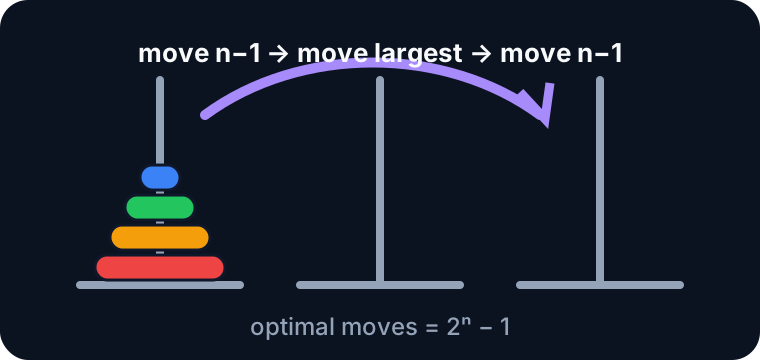
Tower of Hanoi looks like disk movement but its structure is recursive. Before the largest disk can move, every smaller disk above it must form a complete tower on the auxiliary peg. After the largest moves, that small tower is rebuilt on the target.
Understand the rules first
Move only the top disk of one peg, and never place a larger disk on a smaller one. Rebuild the full ordered tower on the marked target peg. A standard three-peg puzzle with n disks has an optimal count of 2ⁿ−1 moves.
Controls and observation
Select the source peg’s top disk and then the destination peg. Illegal destinations do nothing. A hint supplies an optimal next move from the current state, but explaining why it is necessary makes the pattern transferable to larger towers.
Strategy by difficulty
Beginner
For three disks, recognize three phases: move the top two to the auxiliary peg, move the largest disk, then move the two-disk tower onto it. Learn “small tower, large disk, small tower” rather than memorizing left/right clicks.
Intermediate
The recursion remains identical as disks increase. To move n disks A→C, move n−1 A→B, move the largest A→C, then move n−1 B→C. Each smaller task follows the same procedure.
Challenge and mastery
In an optimal run, the smallest disk moves every other turn in a fixed cycle. Its initial direction differs for odd and even disk counts. The lower bound proves optimality: moving the largest requires at least 2^(n−1)-1 moves both before and after its single move.
A reliable solving routine
-
Identify source, target, and auxiliary pegs for the current stage.
-
Move the smaller tower above the largest as a recursive subproblem.
-
Move the current largest disk to its target.
-
Apply the same method to rebuild the small tower above it.
Common mistakes
- Following whatever small-disk move is available without a large-disk stage goal.
- Violating the invariant by placing a large disk on a smaller one.
- Memorizing left/right sequences that fail when the target peg changes.
Practice advice
Complete three disks in exactly 7 moves and four in 15. Before every move, name whether it belongs to clearing the small tower, moving the largest disk, or rebuilding the tower.
Quick answer
Tower of Hanoi looks like disk movement but its structure is recursive. Before the largest disk can move, every smaller disk above it must form a complete tower on the auxiliary peg. After the largest moves, that small tower is rebuilt on the target. Use this as the main decision rule: before every action, say what constraint it satisfies and what future option it preserves.
A worked attempt: think before acting
A useful first-pass approach is: for three disks, recognize three phases: move the top two to the auxiliary peg, move the largest disk, then move the two-disk tower onto it. Learn “small tower, large disk, small tower” rather than memorizing left/right clicks. After that move, pause and compare the actual state with the one you predicted. If they differ, correct the model before adding more actions.
Now test the opposite of a common failure: following whatever small-disk move is available without a large-disk stage goal. Instead of repeating that pattern, undo to the first decision that created it and choose the move that leaves more legal continuations. This turns an apparent mistake into a reusable solving example.
How the difficulty curve changes
Early levels isolate one rule so the result of each move is easy to see. Intermediate levels combine two rules and make move order important. Challenge levels add look-alike states, tighter space, or longer dependencies. Mastery means explaining why a move is safe, not merely remembering a solution.
For a new level, use three passes:
-
Map: identify fixed goals, movable parts, forbidden states, and scarce spaces.
-
Plan: choose one short milestone that can be checked immediately.
-
Verify: after reaching it, confirm that the next milestone remains possible.
Frequently asked questions
What should I focus on first in Tower of Hanoi?
Start with the most restrictive rule described at the top of this guide. Forced moves, narrow corridors, limited capacity, or unique candidates reduce the search space fastest.
What is the most common reason a valid move becomes a bad move?
A move can be legal now but destroy a future option. The warning sign in this puzzle is: following whatever small-disk move is available without a large-disk stage goal. Check the state one or two actions ahead before committing.
How do I know whether I am improving?
Track one measure at a time: fewer restarts, fewer undos, lower move count, better accuracy, or the ability to explain each choice. A faster time is meaningful only when correctness stays stable.
Are the daily and shared challenges different from ordinary levels?
They use the same game rules. The daily challenge provides a date-based common puzzle, while a challenge link preserves a specific level or state so two players can compare decisions on equal terms.
Key terms
- State: all information needed to determine the next legal actions.
- Constraint: a rule that eliminates impossible choices.
- Look-ahead: predicting the result of one or more actions before making them.
- Dead end: a legal-looking state from which the goal can no longer be reached.
- Efficiency: useful progress per move rather than motion for its own sake.
A deliberate practice routine
Play once without worrying about score. On the second attempt, stop at the first uncertainty and state two candidate actions. Predict the consequence of each, choose one, and use undo only to test the prediction. On the third attempt, aim to remove one unnecessary reversal or guess.
Use the daily challenge for transfer: it prevents you from memorising only a fixed level sequence. Use shared challenges for explanation: send the exact puzzle, compare the first point where your routes differ, and discuss which future option each move preserved.