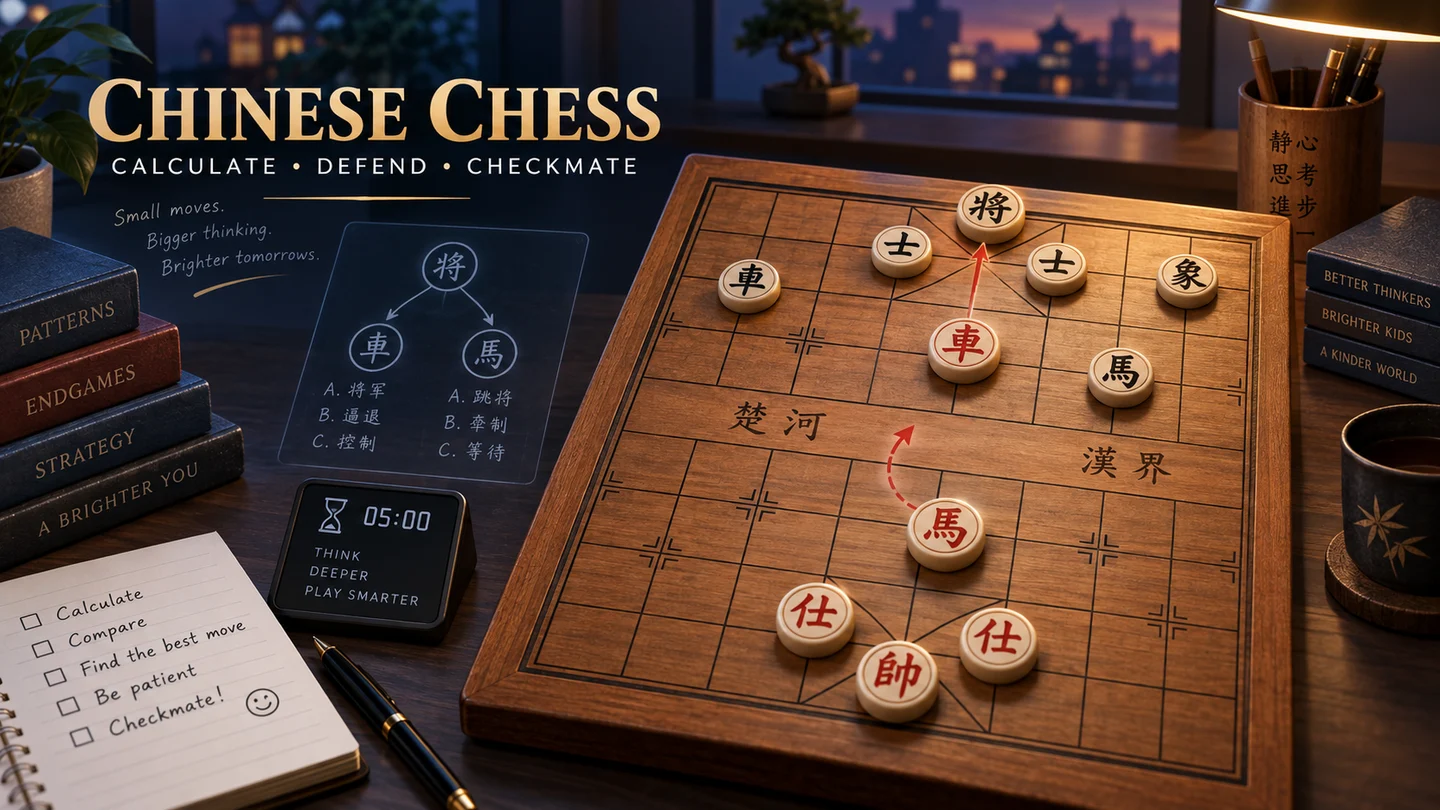
Chinese Chess Strategy Guide: Rules, Development, Tactics, and Endgames
Chinese Chess, or Xiangqi, is a game of open lines, tempo, and coordinated attacks. The board has a river, two palaces, and pieces whose movement depends on blockers. These features make calculation feel different from international chess: a cannon may become powerful because of an intervening screen, while a horse can lose a move because its first step is blocked.
Quick answer: how to think on every turn
Use this order: answer checks, look for checks, examine captures, identify threats, then improve your least active piece. Before moving, confirm that your general remains safe and that the two generals will not face each other on an open file.
The board and win condition
The board contains 9 files and 10 ranks, with pieces placed on intersections. Red moves first. Each general is restricted to its 3×3 palace. The river divides the two sides and changes the movement of soldiers and elephants.
You win by checkmating the opposing general or leaving the opponent with no legal move. Unlike international chess, stalemate is a loss for the immobilized side. YouToStem follows the core movement, check, mate, and stalemate requirements described in the Chinese Xiangqi Association 2020 rules and the Asian Xiangqi Federation rules.
How every piece moves
General
The general moves one intersection horizontally or vertically and stays inside the palace. The two generals may not face each other on the same open file. With no intervening piece, a general also attacks the opposing general along that file—the flying-general rule.
Advisor
Advisors move one step diagonally and remain in the palace. They protect key palace points but can also block the general’s escape, so defensive pieces require coordination.
Elephant
Elephants move exactly two points diagonally and may not cross the river. The midpoint must be empty; a blocker there “closes the elephant’s eye.” Their main job is home-side defense.
Horse
A horse moves one orthogonal step followed by one diagonal step outward. It cannot jump over a piece on the first orthogonal point. This “horse-leg” rule creates pins and tactical blocks that do not exist in international chess.
Chariot
The chariot moves any distance horizontally or vertically through empty points. It is the strongest mobile piece. Open files and ranks are valuable because a chariot can attack, defend, and restrict the palace at once.
Cannon
A cannon moves like a chariot when it is not capturing. To capture, exactly one piece of either color must stand between the cannon and its target. That intervening piece is the screen. Adding or removing a screen can change several attacks immediately.
Soldier
A soldier moves one step forward. After crossing the river, it may also move one step sideways, but never backward. Advanced soldiers gain value because they control palace approaches and restrict defensive movement.
Opening principles
Develop pieces before launching a one-piece attack. Horses need open legs, cannons need useful screens, and chariots need ranks or files. Moving the same cannon repeatedly while the chariots remain trapped usually gives the opponent time to organize.
Keep the central file under observation. A central cannon may create pressure, but opening the file carelessly can expose your own general. Make sure at least one piece remains between the generals unless the resulting flying-general attack is part of a legal tactic.
A four-step tactical scan
-
Check: Is your general attacked? If so, every candidate must resolve the check.
-
Forcing moves: Can you check the opponent, make a valuable capture, or create a direct threat?
-
Opponent reply: After your candidate, what is the strongest check or capture available to the opponent?
-
Position after the exchange: Which pieces remain active, and whose palace is safer?
This short sequence is more reliable than selecting a move only because it captures material.
Cannon and horse coordination
Cannons are strongest when you manage screens deliberately. A friendly soldier can be a temporary screen, while an enemy advisor may become a forced screen inside the palace. Before moving any piece on a cannon line, re-evaluate both cannons.
Horses control nearby palace points efficiently, but check the leg first. A defending side can neutralize a horse by occupying its leg; an attacking side may remove that blocker with a chariot or cannon before delivering the decisive check.
Endgame method
Reduced positions reward exact calculation. Start with three questions:
- Which palace intersections can the enemy general legally enter?
- Which of those points are controlled by your general, chariot, horse, cannon, or advanced soldier?
- Can the defender capture the checking piece, block the line, or move the cannon screen?
In Xiangqi, your own general is an attacking piece because the flying-general rule controls a file. Move it safely toward the center of its palace when that removes an enemy escape square.
The daily challenge is an endgame because fewer pieces make cause and effect easier to inspect. The hint button highlights one engine recommendation without moving automatically; try to explain the move before playing it.
Difficulty bands
Beginner: Levels 1–30
The computer searches one ply and intentionally chooses among several reasonable moves. Focus on legal movement, safe development, and noticing direct attacks.
Intermediate: Levels 31–60
The search looks at replies and reduces variation. Before each move, calculate at least your move and the opponent’s best response.
Advanced: Levels 61–90
The engine consistently chooses its highest evaluation. Tactics involving screens, horse legs, and exchanges become more important than unsupported attacks.
Master: Levels 91–120
The computer searches deeper. Preserve initiative, but do not confuse repeated checks with progress. A forcing sequence is useful only if it improves the final position.
Repetition and browser-game scope
Official perpetual-check and perpetual-chase decisions can depend on detailed responsibility analysis. The web game implements all core movement and king-safety rules, then uses a clear casual-play limit: the same position with the same side to move three times is a draw, and a 200-ply game is also a draw. This avoids endless loops without pretending to replace tournament arbitration.
Common mistakes
- Moving a horse while its leg is blocked.
- Treating a cannon like a capturing chariot without exactly one screen.
- Opening the central file and accidentally exposing the generals.
- Counting material but ignoring a forced check sequence.
- Leaving both chariots trapped while repeating early cannon moves.
- Forgetting that stalemate defeats the side with no legal move.
A deliberate practice routine
Play one Beginner level and pause before every move. Say the opponent’s strongest check aloud. In a second game, track one cannon line and predict how every screen change affects it. Then solve the daily endgame without hints; if stuck, request one hint and explain why it restricts the opposing palace.
Shared challenges preserve the level and endgame seed. Compare the first position where two players chose different moves and evaluate checks, captures, threats, and palace safety for both choices.
Frequently asked questions
Should I always give check when possible?
No. A check that improves piece activity or forces the general onto a worse point is valuable. A check that simply repeats the position may waste time or lead to a draw under the browser rule.
Why did the game reject a move that looked legal?
The move may have exposed your general, opened a flying-general file, crossed the river with an elephant, ignored a horse-leg blocker, or used the wrong number of cannon screens.
What is the best first skill for children?
Learn to identify attacks before learning openings. Ask “What changed after that move?” This builds board awareness and transferable cause-and-effect reasoning.